
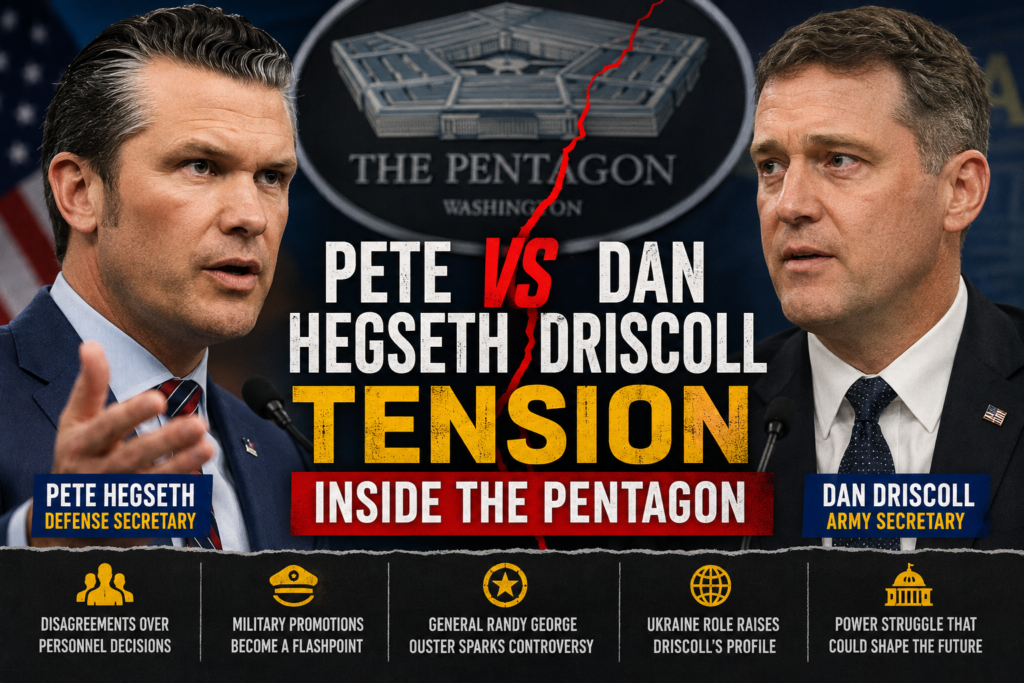

The pete hegseth dan driscoll tension has become one of the more closely watched internal conflicts in the Pentagon, raising questions about leadership, military promotions, personnel decisions, and the balance of power inside the Trump administration. Pete Hegseth, the U.S. defense secretary, and Dan Driscoll, the Army secretary, occupy different positions in the military chain of command, but their relationship has reportedly become increasingly strained.
Reports in 2026 have described disagreements between the two officials over senior personnel, Army promotions, military leadership, and Driscoll’s expanding profile within the administration. The dispute has attracted even more attention because Driscoll has been praised by the White House for his work and has also taken on an unusual diplomatic role involving Ukraine. (The Washington Post)
The situation is important because disagreements among senior civilian defense officials can affect more than Washington politics. They can influence military leadership, acquisition programs, strategic priorities, and the confidence of officers working within the Pentagon. Understanding the background helps explain why the relationship between Hegseth and Driscoll has become such a significant story.
Why Pete Hegseth and Dan Driscoll Are at the Center of Attention
Pete Hegseth serves as the head of the U.S. Department of Defense, giving him authority over the military departments and responsibility for translating the president’s defense priorities into policy. Dan Driscoll, meanwhile, serves as secretary of the Army and oversees the civilian leadership of the Army. Their positions naturally require close coordination, even though they have different responsibilities.
The pete hegseth dan driscoll tension reportedly goes beyond an ordinary policy disagreement. Several reports have described a relationship marked by friction over personnel decisions and questions about influence. The Washington Post reported that tensions had been building for months and that officials questioned whether the two men could continue working together smoothly. (The Washington Post)
This makes the dispute particularly interesting because both men were appointed by the same administration. In theory, they should be working toward common objectives. In practice, differences in management style, political relationships, and views about military personnel can create significant pressure at the highest levels.
How the Conflict Began to Develop
The roots of the pete hegseth dan driscoll tension reportedly stretch back to 2025. According to reporting, Driscoll’s name was at one point discussed inside the administration as a possible replacement for Hegseth. That speculation reportedly emerged during a period when Hegseth was facing political controversies and uncertainty about his position. (The Washington Post)
That possibility matters because Driscoll is not simply another senior Pentagon official. He has a close relationship with Vice President JD Vance and developed a higher public profile through his work on Army modernization and later diplomacy involving Ukraine. The combination of political connections and increased visibility may have contributed to perceptions that Driscoll could become an alternative source of influence within the administration.
It is important, however, to distinguish documented events from interpretations attributed to unnamed officials. Pentagon spokespersons have rejected the characterization of the relationship as an ongoing feud. Sean Parnell, Hegseth’s spokesman, has said that Hegseth maintains strong working relationships with service secretaries, including Driscoll. (The Washington Post)
Personnel Decisions Became a Major Flashpoint
One of the clearest examples of the disagreement involved Army personnel. In February 2026, reports said Hegseth directed Driscoll to remove Col. David Butler, a senior Army adviser and spokesman. Butler had worked with Driscoll and Army Chief of Staff Gen. Randy George and had previously worked for former Joint Chiefs Chairman Gen. Mark Milley. (The Washington Post)
The episode highlighted the difficulty of separating individual personnel decisions from broader political tensions. Butler was reportedly respected within Army leadership, while Hegseth had concerns about his previous associations. The disagreement became another example cited by observers trying to understand the pete hegseth dan driscoll tension.
The controversy also demonstrated how decisions involving individual officers can become symbols of larger disagreements. In Washington, a personnel move is rarely viewed in isolation when senior officials already have a complicated relationship.
Army Promotions Added More Pressure
Military promotions became another important part of the story. Reports in March 2026 said Hegseth intervened in an Army promotion list involving officers being considered for one-star general positions. According to reporting, Driscoll resisted removing certain names from the list, while Hegseth ultimately intervened. (EveryCRSReport)
The Pentagon has maintained that promotions should be based on merit and has rejected allegations that race or gender were used improperly in the selection process. Nevertheless, Hegseth’s direct involvement in promotion decisions raised broader questions about the traditional relationship between civilian defense leadership and military personnel processes.
The issue is significant because promotion systems are central to military professionalism. Senior officers need confidence that career advancement will be determined by performance, qualifications, leadership, and established procedures. When civilian leaders intervene directly, it can generate debate about where political authority ends and military institutional judgment begins.
The Ouster of General Randy George Changed the Story
The pete hegseth dan driscoll tension became much more serious after Gen. Randy George, the Army chief of staff, was pushed out in early April 2026. George was considered an important figure in Driscoll’s leadership team, making his removal particularly significant.
The Washington Post reported that George’s departure came alongside the removal of other senior Army generals. The timing was especially striking because the United States was dealing with major wartime commitments. (The Washington Post)
Driscoll subsequently said he had no plans to resign. His statement was direct:
“I have no plans to depart or resign as the Secretary of the Army.” (The Washington Post)
That statement mattered because it addressed widespread speculation about his future. Rather than quietly stepping aside, Driscoll publicly indicated that he intended to remain focused on his position.
The Ukraine Role Increased Driscoll’s Profile
Another factor behind the pete hegseth dan driscoll tension was Driscoll’s involvement in Ukraine diplomacy. His role expanded beyond the conventional duties associated with an Army secretary when the Trump administration used him as a participant in efforts related to negotiations between Russia and Ukraine.
Driscoll’s involvement attracted international attention because he was primarily known as an Army official rather than a traditional diplomat. His work also reinforced his reputation inside the administration as a politically useful and energetic figure. The Financial Times reported that his role in Ukraine negotiations contributed to his growing profile and highlighted his relationship with Vice President Vance. (Financial Times)
This created an unusual situation. Driscoll was simultaneously responsible for Army leadership and becoming involved in major foreign-policy discussions. The expanded role potentially increased his visibility relative to other Pentagon officials, making speculation about his long-term political future even more intense.
A Look at the Main Issues
| Issue | Why It Matters | Reported Impact |
|---|---|---|
| Senior personnel decisions | Determines who holds influential military positions | Increased friction |
| Army promotion lists | Affects officer careers and institutional confidence | Became a major disagreement |
| Gen. Randy George’s removal | Changed Army leadership | Intensified questions about Driscoll’s position |
| Ukraine diplomacy | Expanded Driscoll’s national profile | Increased political speculation |
| Pentagon authority | Defines who controls military decisions | Raised questions about civilian leadership |
| Political relationships | Can influence perceptions of future leadership | Added to rivalry speculation |
The table shows why the pete hegseth dan driscoll tension cannot be reduced to one disagreement. Instead, several separate issues appear to have reinforced one another over time.
What Hegseth’s Supporters Say
Supporters of Hegseth argue that the defense secretary has the authority to reshape military leadership and implement the president’s priorities. From this perspective, personnel changes can be part of a broader effort to make the Pentagon more responsive to the administration.
Hegseth has emphasized military readiness, modernization, merit-based promotions, and a transformation of defense priorities. The Pentagon has also defended his leadership and rejected claims that personnel decisions are driven by improper considerations. (The Guardian)
From this viewpoint, what critics describe as a power struggle could instead be seen as a strong civilian leader exercising authority over the military. The challenge is that the more aggressively leadership changes are implemented, the more likely they are to produce resistance from existing institutions.
What Critics of the Pentagon Shake-Up Say
Critics argue that the rapid removal or reassignment of senior officers can damage stability and institutional continuity. The concern becomes especially serious when changes involve experienced commanders during periods of military conflict.
Congressional reactions also demonstrated that the issue had crossed political boundaries. At an April 2026 hearing, lawmakers from both parties expressed support for Driscoll and concern about the removal of Gen. Randy George. (The Washington Post)
That bipartisan attention is notable. Defense policy is often highly partisan, but military leadership changes can generate concern among lawmakers who normally support the administration. For critics, the central question is not whether civilian leaders have authority, but whether that authority is being exercised in a way that strengthens or weakens military effectiveness.
Why Driscoll Has Remained Important to the Trump Administration
Dan Driscoll’s rise is an important part of understanding the story. He was appointed Army secretary in 2025 and quickly became associated with military modernization, particularly the growing importance of drones and emerging technologies.
His background is also unusual for someone operating at the intersection of military policy and national diplomacy. His relationship with JD Vance has been widely discussed, and his role in Ukraine negotiations demonstrated that the White House was willing to give him responsibilities beyond traditional Army administration. (The Guardian)
This explains why the pete hegseth dan driscoll tension has attracted so much attention. Driscoll is not simply a subordinate official with limited visibility. He has developed his own network, policy reputation, and relationship with influential figures in the administration.
Is This Really a Personal Feud?
Calling the situation a personal feud may be tempting, but the available evidence suggests a mixture of personal friction, policy disagreements, personnel disputes, and competing perceptions of authority.
Some officials have described the relationship as tense, while Pentagon representatives have denied that the two men have a fundamentally dysfunctional working relationship. The conflicting descriptions are important because much of the reporting about internal government relationships comes from anonymous officials. (The Washington Post)
Therefore, readers should be cautious about treating every rumor as established fact. There is strong reporting that disagreements occurred, but claims about private motivations or future plans should be presented as allegations rather than proven conclusions.
What the Conflict Could Mean for the Pentagon
The most important consequence of the pete hegseth dan driscoll tension may not be who wins a political contest. The bigger issue is how continued leadership disagreements affect the Pentagon’s ability to operate efficiently.
Military organizations depend heavily on predictable chains of command. Senior civilian officials must be able to disagree without creating uncertainty for the officers and civilian employees beneath them. If personnel decisions become associated with internal political battles, institutional confidence can suffer.
There is also a practical concern. The Army is undergoing significant modernization, while the United States faces military commitments in multiple regions. A prolonged leadership dispute could distract senior officials from procurement, readiness, force structure, technology development, and strategic planning.
What Happens Next?
The future of the pete hegseth dan driscoll tension remains difficult to predict. Driscoll has publicly indicated that he intends to remain Army secretary, while Hegseth continues to exercise significant influence over defense policy and military leadership.
One important development is that the Army Transformation Initiative itself has been subject to further review. Congressional research reported that Hegseth indicated in May 2026 that some aspects of the initiative would receive another look, while Driscoll said the Army would work with the defense secretary’s office to ensure that the services were aligned. (EveryCRSReport)
That suggests the relationship may evolve from open disagreement toward negotiation over policy. Even when senior officials disagree, government institutions often continue functioning through compromise, clarification of authority, and political intervention from the White House.
The Bigger Lesson About Civilian Military Leadership
The pete hegseth dan driscoll tension also illustrates a larger issue in American government: the relationship between civilian control and military expertise.
Civilian officials have the authority to set national defense policy. At the same time, military professionals bring decades of operational experience to decisions involving personnel, readiness, strategy, and command. A healthy system requires both sides to understand their responsibilities.
Disagreements are not automatically signs of institutional failure. In fact, disagreement can be useful when it leads to better decisions. The real concern arises when disagreements become personal, unpredictable, or disruptive to the chain of command.
For that reason, the long-term significance of the dispute will depend less on headlines and more on whether the Pentagon can maintain effective decision-making while senior leaders pursue different priorities.
Frequently Asked Questions
What is the Pete Hegseth Dan Driscoll tension about?
The pete hegseth dan driscoll tension refers to reported disagreements between Defense Secretary Pete Hegseth and Army Secretary Dan Driscoll involving personnel decisions, military promotions, leadership changes, and broader questions of influence inside the Pentagon. Reports indicate that the relationship became particularly strained after disputes involving senior Army officials.
Why did Dan Driscoll say he was not resigning?
Dan Driscoll publicly stated in April 2026 that he had no plans to leave or resign as Army secretary. His statement came after reports about tensions with Hegseth and after the removal of Gen. Randy George and other senior Army leaders. (The Washington Post)
Did Pete Hegseth and Dan Driscoll disagree over military promotions?
Yes. Reporting in 2026 described disagreements over Army promotion lists and Hegseth’s involvement in the process. The Pentagon has said that military promotions are based on merit and has rejected allegations that race or gender were improperly used as selection factors. (The Guardian)
Why was Gen. Randy George’s removal significant?
Gen. Randy George was the Army chief of staff and was considered closely connected to Driscoll’s leadership team. His removal in April 2026 intensified scrutiny of the pete hegseth dan driscoll tension because it occurred after months of reported disagreements between Hegseth and senior Army officials. (The Washington Post)
Could Dan Driscoll replace Pete Hegseth?
Speculation about Driscoll potentially becoming defense secretary has appeared in reporting, particularly because of his political relationship with Vice President JD Vance and his growing role within the administration. However, speculation about a possible successor should not be treated as confirmation that a change is planned. (The Washington Post)
Has the Pentagon confirmed that Hegseth and Driscoll are feuding?
No. Pentagon officials have disputed descriptions of the relationship as a serious feud. Hegseth’s spokesman has said that the defense secretary maintains good working relationships with the service secretaries, including Driscoll. At the same time, multiple news reports have documented disagreements and friction between the two officials. (The Washington Post)
Conclusion
The pete hegseth dan driscoll tension is best understood as a combination of leadership disagreements, personnel disputes, political relationships, and competing visions for how the Pentagon should operate. The situation became more visible after the removal of senior Army leaders and continued discussion over promotions and military policy.
At the same time, it is important not to turn every disagreement into a confirmed personal feud. Some claims come from unnamed sources, while Pentagon officials have offered a more positive description of the relationship. The clearest facts are that disagreements have been reported, major personnel changes have occurred, and Driscoll has publicly rejected suggestions that he intends to resign.
As the Trump administration continues its defense reforms, the relationship between Hegseth and Driscoll will remain worth watching. Their ability to manage differences could have consequences far beyond Washington politics, affecting Army modernization, military leadership, personnel policy, and the broader direction of U.S. defense strategy.