
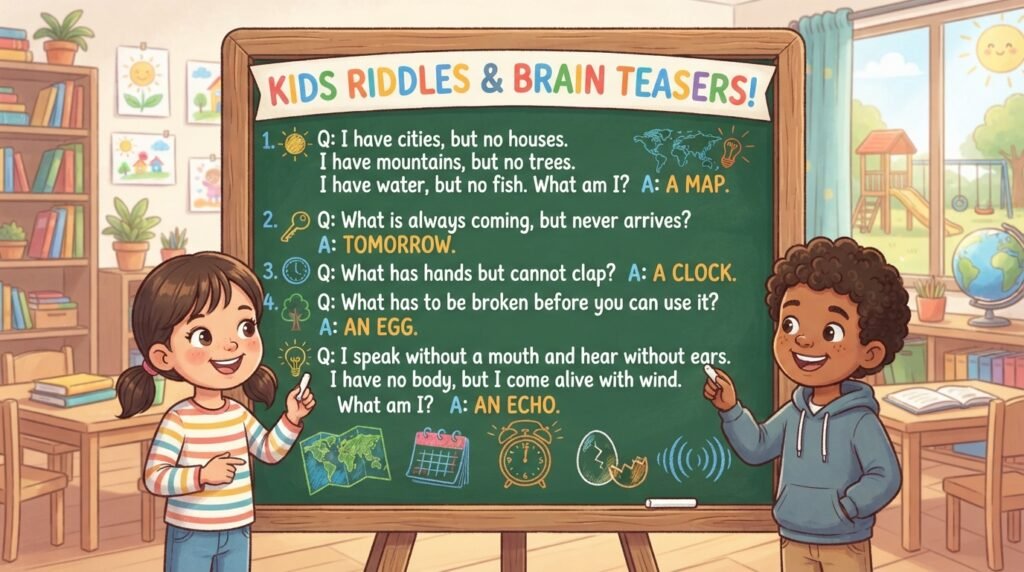

Kids riddles are a simple and entertaining way to turn everyday moments into opportunities for learning, laughter, and creative thinking. Whether you are looking for quick brain teasers for a family game night, classroom activities, birthday parties, road trips, or quiet time at home, riddles can keep children engaged without making learning feel like work.
A good riddle encourages children to listen carefully, notice clues, think beyond the obvious answer, and explain how they reached a conclusion. Unlike ordinary questions, riddles often require flexible thinking. A child may need to look at a familiar object from a completely different perspective before the answer becomes clear.
From easy animal riddles to funny school jokes and tricky word puzzles, there is a huge variety to explore. The best choices are age-appropriate, understandable, and challenging enough to make children think without becoming frustrating.
Why Kids Riddles Are Great for Learning
Kids riddles are more than simple entertainment. They can support important cognitive skills by asking children to process information, identify patterns, and connect clues with possible answers. When children solve a puzzle, they are practicing reasoning in a playful environment.
Riddles can also help develop language skills. Children encounter descriptions, wordplay, comparisons, and multiple meanings while trying to understand a question. This makes them particularly useful for parents and teachers who want to introduce vocabulary and comprehension activities in an enjoyable way.
“A great riddle does not simply give a child an answer; it encourages the child to discover one.”
Another advantage is that riddles can create conversation. Instead of immediately revealing the solution, an adult can ask a child why they think a particular answer makes sense. This encourages children to explain their reasoning and listen to alternative ideas.
The activity can be adapted for different ages, too. Younger children can enjoy straightforward object and animal clues, while older children may prefer wordplay, logic puzzles, and riddles with unexpected solutions.
Easy Kids Riddles for Younger Children
Simple riddles are an excellent starting point for preschoolers and early elementary students. At this stage, children usually respond best to familiar subjects such as animals, food, weather, toys, colors, and household objects.
For example, a riddle might ask: “I have four legs, but I cannot walk. What am I?” A child may think about animals first, but the answer could be a table. The fun comes from realizing that the clue has another possible interpretation.
Easy riddles should generally have clues that children can understand without requiring advanced vocabulary. The goal is to make children feel successful while gradually introducing them to the idea of thinking differently.
Here are a few examples:
| Riddle | Answer | Skill Encouraged |
|---|---|---|
| What has four legs but cannot walk? | A table | Flexible thinking |
| What has hands but cannot clap? | A clock | Word association |
| What has a face and two hands but no arms? | A clock | Observation |
| What gets wetter as it dries? | A towel | Logical reasoning |
| What has many teeth but cannot bite? | A comb | Creative thinking |
| What can you catch but cannot throw? | A cold | Language skills |
Parents can read one riddle at a time and allow children to think before offering hints. Even when the answer seems obvious to an adult, giving children enough time to reach the solution independently can make the experience much more rewarding.
Funny Kids Riddles That Make Children Laugh
Humor can make learning activities much more memorable. Funny kids riddles often combine an ordinary question with an unexpected answer, creating a small surprise that children enjoy sharing with friends and family.
For instance, you might ask, “Why did the math book look sad?” The answer is, “Because it had too many problems.” This type of wordplay is especially enjoyable for school-age children because it combines language with humor.
Funny riddles can also become excellent conversation starters. Children may repeat their favorite jokes to siblings, classmates, parents, or teachers. Sharing the puzzle gives them a chance to practice communication while entertaining someone else.
The best humorous riddles are clean, age-appropriate, and easy enough to understand. A joke that requires complicated cultural references or advanced vocabulary may not work well with younger children.
Animal Riddles for Curious Kids
Animals are one of the easiest themes for children’s brain teasers because most children already have some knowledge about them. A riddle about a lion, elephant, cat, dog, bird, or fish can connect a familiar subject with a new way of thinking.
Consider a question such as, “I have feathers, wings, and a beak, but I am not necessarily able to fly. What am I?” The clues encourage children to think about birds while remembering that not every bird flies.
Animal puzzles can also be educational. Parents and teachers can add a short fact after revealing each answer. For example, after a child solves a penguin riddle, you can explain that penguins are birds even though they cannot fly through the air.
This approach transforms a simple game into an informal learning experience. Children are more likely to remember information when it is connected to something amusing or interactive.
Tricky Kids Riddles for Older Children
Once children become comfortable with basic puzzles, it can be fun to introduce more challenging questions. Tricky kids riddles often use double meanings, assumptions, or clues that encourage the solver to approach the problem from another angle.
For example: “What has a neck but no head?” The answer is a bottle. Children may initially think about living things, but the clue uses “neck” to describe part of an object.
Another classic example is: “What belongs to you, but other people use it more than you do?” The answer is your name. This kind of puzzle encourages children to reconsider the meaning of familiar words.
When presenting harder riddles, avoid making the experience feel like a test. If a child cannot solve one, offer a small hint rather than immediately giving away the answer. The process of trying different possibilities is often more valuable than getting every answer correct.
Riddles for Kids That Build Problem-Solving Skills
Problem-solving involves more than knowing facts. Children need to recognize information, compare possibilities, test ideas, and sometimes change their approach. Riddles provide a low-pressure way to practice these habits.
A child solving a brain teaser may first make an incorrect guess. That is perfectly normal. You can ask, “Which clue does not fit your answer?” This simple question encourages the child to evaluate their reasoning instead of feeling discouraged.
Logical riddles can be particularly useful for developing this skill. Some may involve numbers, patterns, objects, or sequences, while others rely on careful reading. Each format challenges children in a slightly different way.
“The most valuable part of solving a puzzle is often the thinking that happens before the answer.”
Parents can also encourage children to create their own riddles. Writing a riddle requires them to choose an answer, identify its characteristics, and turn those characteristics into clues. That is a surprisingly effective creative-writing activity.
Kids Riddles for Classroom Activities
Teachers can use riddles as warm-up exercises, transition activities, or short breaks between lessons. A quick puzzle can help students refocus their attention without requiring a lengthy activity.
For example, a teacher might write a riddle on the board at the beginning of class and let students discuss possible answers with a partner. Students can then explain their reasoning to the class.
Riddles can also connect with academic subjects. Math riddles can reinforce arithmetic and patterns, science riddles can introduce animals or natural phenomena, and vocabulary riddles can help students explore word meanings.
The key is to match the difficulty with the children’s age and learning level. A puzzle should provide enough challenge to encourage thinking while remaining accessible to most students.
How Parents Can Make Riddles More Interactive
Parents do not need special equipment to turn riddles into a fun family activity. A few questions can be enough to create a mini game during dinner, while traveling, or before bedtime.
Try giving children different roles. One child can read the riddle, another can guess, and a third can provide a hint. Older children can even become the “riddle master” and create puzzles for everyone else.
You can also introduce a gentle scoring system if your children enjoy competition. However, winning should not be the main goal. Encourage creative answers and explanations, especially when a child’s interpretation is reasonable even if it is not the intended answer.
Another fun idea is to create a riddle jar. Write simple brain teasers on small pieces of paper and place them in a container. Each day, choose one at random and solve it together.
How to Choose Age-Appropriate Kids Riddles
Not every puzzle is suitable for every child. A riddle that seems easy to a ten-year-old may be confusing for a preschooler. Choosing appropriate difficulty is therefore important.
For younger children, focus on familiar objects, animals, colors, food, and basic actions. Keep the clues short and avoid complicated wordplay.
For older children, you can introduce logic puzzles, puns, lateral-thinking challenges, and riddles with multiple clues. Children who already enjoy puzzles may appreciate questions that initially seem impossible but have a simple explanation.
The table below provides a general guide:
| Age Group | Recommended Riddle Style | Examples of Topics |
|---|---|---|
| Preschool | Very easy clues | Animals, toys, colors |
| Early elementary | Simple wordplay | Food, school, objects |
| Middle elementary | Tricky clues | Nature, language, logic |
| Older children | More complex puzzles | Patterns, lateral thinking, wordplay |
Remember that age is only a guideline. Children’s reading ability, vocabulary, interests, and previous experience with puzzles can all affect how difficult a riddle feels.
Creative Ways to Use Kids Riddles at Home
There are countless ways to make kids riddles part of everyday family life. A few puzzles can be used during breakfast, after school, on a long car ride, or as a screen-free bedtime activity.
You could also turn riddles into a scavenger hunt. Each solved puzzle gives the child a clue leading to the next location. This adds movement and excitement while encouraging children to think carefully about every answer.
Birthday parties can benefit from riddle games as well. Children can work individually or in teams to solve age-appropriate puzzles. For a classroom or group setting, writing answers on small cards can make the activity easier to organize.
Another creative option is a “riddle of the day.” Put one puzzle on a refrigerator, whiteboard, or family message board. Everyone gets a chance to think about it throughout the day before the answer is revealed.
Related Keywords for Kids Riddles
Using related search terms naturally can help create a more comprehensive topic without repeating the main keyword unnecessarily. Relevant phrases include riddles for children, easy riddles for kids, funny riddles for kids, brain teasers for kids, tricky riddles, animal riddles, educational riddles, children’s puzzles, logic puzzles for kids, and fun brain games.
These related keywords reflect different search intentions. Someone searching for easy riddles may have a young child, while someone searching for brain teasers could be looking for more challenging puzzles.
A well-optimized article should satisfy these different needs naturally rather than forcing keywords into every paragraph. Helpful information, clear organization, and useful examples are more important than excessive repetition.
Common Mistakes to Avoid When Giving Riddles
One common mistake is choosing puzzles that are too difficult. If children repeatedly hear riddles they cannot solve, they may stop enjoying the activity. Difficulty should increase gradually as their confidence grows.
Another mistake is giving away the answer too quickly. Adults often know the solution immediately and may forget that children need time to process the clues. Give them a moment to think and encourage them to explain their guesses.
It is also important to avoid embarrassing children when they make an incorrect guess. Riddles are supposed to encourage curiosity and experimentation. A wrong answer can become a useful opportunity to discuss why certain clues do or do not fit.
Finally, remember that some riddles have more than one reasonable interpretation. If a child provides a creative answer that fits the clues, discuss it rather than automatically marking it wrong.
Conclusion
Kids riddles offer a simple way to combine entertainment, learning, creativity, and family interaction. From easy animal puzzles for young children to tricky wordplay for older students, there is a riddle style for almost every age and interest.
The real value of these activities goes beyond finding the correct answer. Children practice listening, vocabulary, reasoning, problem-solving, imagination, and communication while having fun. Parents and teachers can make the experience even more valuable by asking children to explain their thinking or create their own puzzles.
Whether you use a few riddles during a family game night or build them into classroom activities, the best approach is to keep the experience relaxed and enjoyable. A good puzzle should make children curious, encourage them to think, and ideally make them smile when they finally discover the answer.
Frequently Asked Questions About Kids Riddles
What are kids riddles?
Kids riddles are short puzzles or brain teasers designed to encourage children to think creatively and logically. They usually provide clues that lead to an object, animal, word, number, or idea.
They can be used for entertainment as well as learning. Depending on the child’s age, riddles can introduce vocabulary, strengthen comprehension, improve reasoning, and encourage flexible thinking.
Why are kids riddles useful for children?
Kids riddles can support problem-solving, language development, memory, reasoning, and creative thinking. Because they are presented as games, children can practice these skills without feeling as though they are completing a formal lesson.
They can also encourage communication. Asking children to explain why they chose an answer helps them organize their thoughts and communicate their reasoning clearly.
What are the best kids riddles for preschoolers?
The best choices for preschoolers are short and easy puzzles involving familiar subjects. Animals, toys, colors, food, weather, and everyday household objects are usually good themes.
Avoid complicated wordplay and unfamiliar vocabulary. The goal at this age should be enjoyment and simple reasoning rather than difficult problem-solving.
How can parents use kids riddles at home?
Parents can use kids riddles during meals, road trips, family game nights, bedtime, or screen-free periods. A daily riddle can become a fun family routine that takes only a few minutes.
You can also make the activity interactive by allowing children to take turns reading puzzles, offering hints, and creating their own riddles. This keeps the experience fresh and encourages creativity.
Are kids riddles educational?
Yes. Many riddles can have educational value because they encourage children to interpret clues, understand language, identify patterns, and think logically. They can also introduce facts about subjects such as animals, science, nature, and mathematics.
However, the educational value depends on how the riddles are used. Discussing the clues and reasoning behind an answer can make the activity much more valuable than simply revealing the solution.
How do you make kids riddles more challenging?
You can make riddles harder by introducing multiple clues, wordplay, lateral-thinking questions, patterns, or less obvious answers. Older children can also be asked to solve riddles where the wording has a double meaning.
Another effective method is to ask children to create their own challenging puzzles. Creating a good riddle requires them to think carefully about an object’s characteristics and how those characteristics can be described without revealing the answer.